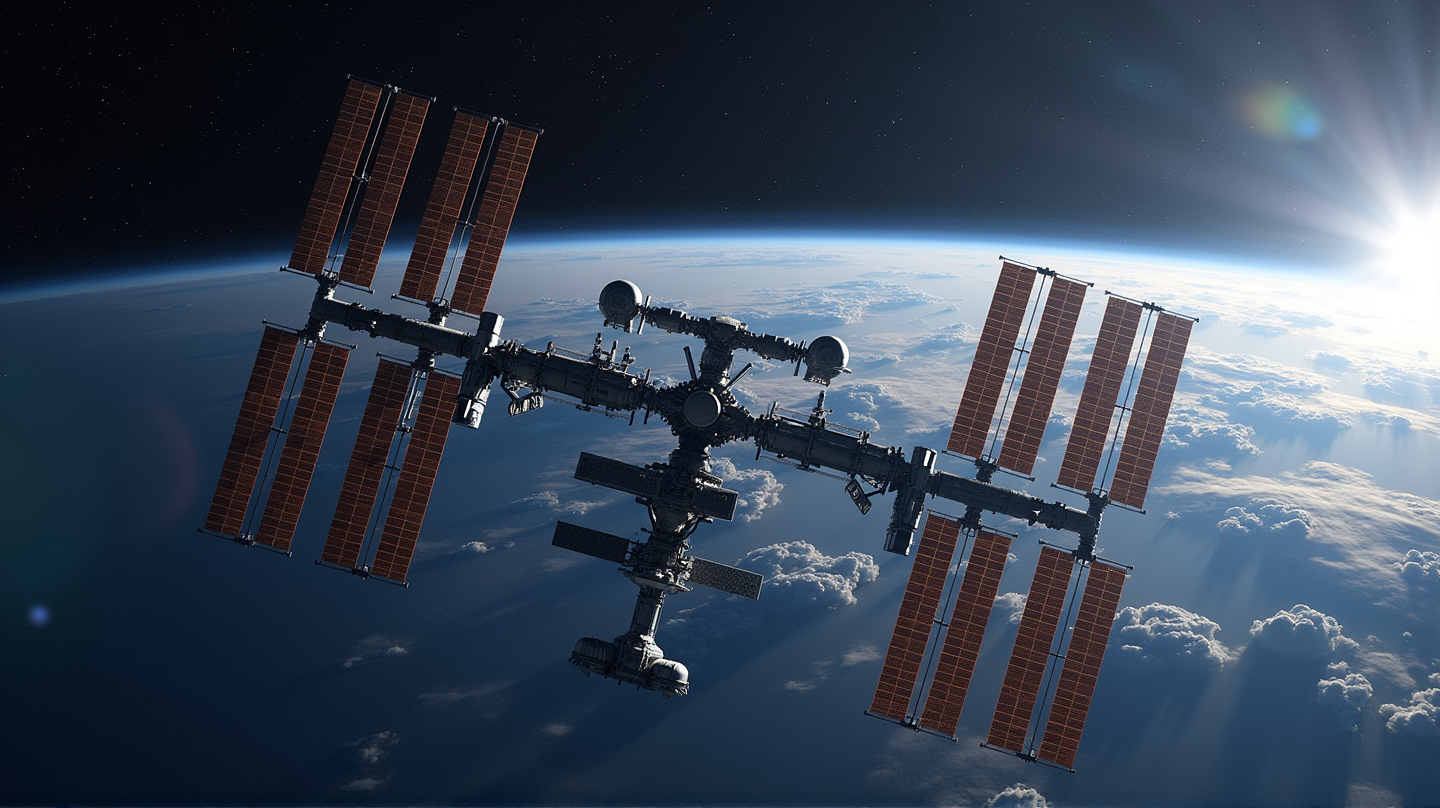
In an extraordinary first for the International Space Station (ISS), all its eight docking ports are fully occupied, marking a significant milestone in human space exploration. This historic achievement underscores a new era of international cooperation and technological advancement in space. According to NASA (.gov), the space station is now a buzzing hive of activity, with diverse spacecraft from various countries and organizations contributing to a unified mission.
A Confluence of Crews and Crafts
As reported on December 1, 2025, the orbital outpost hosts an impressive array of vehicles: two SpaceX Dragons, JAXA’s HTV-X1, Northrop Grumman’s Cygnus XL, two Roscosmos Soyuz crew spacecraft, and two Progress cargo ships. This diverse ensemble not only symbolizes global unity but also enhances the station’s capabilities for scientific research and exploration.
Synergy and Coordination
The seamless docking of spacecraft required meticulous coordination involving NASA, Northrop Grumman, JAXA, and Roscosmos. Recently, the Cygnus XL was expertly repositioned using the station’s Canadarm2 to accommodate a crewed Soyuz arrival. This embodies a perfect synergy of international agencies, working together to overcome logistical challenges and maximize the space station’s potential.
Life Aboard the Packed Space Station
Onboard, the 10-member Expedition 73 crew is busily engaged in groundbreaking research that will have far-reaching impacts on life both on Earth and in space. Experiments range from biological studies to innovative physics projects, all facilitated by the unique conditions of microgravity the station offers.
A Focus on Human Adaptation
NASA astronaut Chris Williams and his colleagues are pioneering studies on how space travel affects human physiology. Their findings promise to unlock new insights into microcirculatory functions, potentially revolutionizing medical approaches back on Earth. Another facet of this research involves cutting-edge liquid crystal experiments, spearheading advancements in materials science and engineering.
Transitioning Teams
As the space station prepares to welcome new explorers, current members of the Expedition 73 crew are concluding their missions. Astronauts Jonny Kim and Sergey Ryzhikov, among others, gear up for their return, handing over critical responsibilities to incoming teams as they prepare the Soyuz MS-27 for a safe return journey.
Continuous Support and Logistics
With the Cygnus XL’s recent cargo delivery, crew members are busy unpacking equipment and supplies vital for ongoing experiments. Efficient logistics ensure that the crew has everything needed for successful and sustained operations in space, demonstrating how human ingenuity continually pushes the boundaries of what is possible.
In this era of space exploration, the ISS stands as a beacon of cooperation and innovation. As humanity looks toward future deep-space exploration missions, the lessons and achievements from this space station milestone lay a robust foundation for the successes yet to come.